About Us

SludgeHammer Group Ltd.’s mission is to help solve the world’s wastewater treatment problems by providing safe, environmentally appropriate, efficient, and effective microbial biotechnology for residential, community, industrial, and marine use.

Residential Wastewater Treatment

Septic and residential wastewater systems can fail when soil becomes clogged over time. SludgeHammer offers a cost-effective, low-maintenance, and sustainable solution to remediate and improve performance without the high cost of replacement.

Commercial Wastewater Treatment

Our commercial products are flexible and scalable to grow with your needs. These innovative products are environmentally conscious and efficient, allowing wastewater to be treated and safely reintroduced to the environment within days.

Winery Wastewater Treatment: Managing High BOD and Seasonal Flow Surges

For wineries, wastewater production is anything but consistent. During harvest and crush seasons, wastewater volumes and organic loads can spike dramatically—sometimes reaching several times the normal daily flow. Without proper planning, these seasonal surges can overwhelm treatment systems and create compliance challenges.

Effective Winery wastewater treatment requires systems that can handle both high biochemical oxygen demand (BOD) and rapid fluctuations in wastewater volume while maintaining stable treatment performance. With the right operational strategies and biological support, wineries can manage these challenges efficiently while protecting both their infrastructure and the environment.

The Challenges of Wastewater Management in Wineries 

Compared to typical domestic wastewater, winery effluent has unique characteristics that can strain conventional treatment systems. 

Winery wastewater commonly contains: 

  • High organic loads from sugars, ethanol, and grape solids
  • Large seasonal fluctuations during harvest and processing
  • Low nutrient levels, which can limit biological treatment efficiency
  • Variable pH, depending on cleaning processes and fermentation activity

These high BOD levels mean treatment systems must rapidly process large organic loads while remaining stable during lower-flow periods outside the harvest season.

The Impact of High BOD on Treatment Systems

BOD is one of the most critical indicators of wastewater strength. High BOD levels indicate a large concentration of biodegradable organic matter, which requires significant microbial activity to break down.

If treatment systems can’t keep up with incoming loads, several problems may occur:

  • Oxygen depletion in biological treatment systems
  • Odors caused by anaerobic conditions
  • Sludge accumulation in tanks or lagoons
  • Reduced treatment efficiency and possible regulatory issues

Biological stability and oxygen availability are key components of successful winery wastewater management.

Managing Seasonal Wastewater Surges

Seasonal production cycles mean wineries must adopt treatment strategies that handle peak loads without sacrificing performance during off-season periods. These strategies can help manage fluctuations: 

Flow Equalization

Equalization tanks help smooth out large spikes in wastewater flow by temporarily storing wastewater before it enters the treatment process. This allows biological systems to process organic loads more consistently rather than experiencing sudden surges.

Recirculation for Biological Stability 

Recirculating wastewater through treatment systems helps maintain active microbial populations even when new wastewater flows are inconsistent.

Systems like the SludgeHammer® 1″ Recirculation Pump help move wastewater through treatment zones. This increases oxygen exposure and improves the efficiency of biological treatment processes. Recirculation also helps prevent solids from settling and accumulating in tanks or lagoons during slower production periods. 

Maintaining Active Microbial Communities

Biological treatment relies on healthy microbial populations that can quickly break down organic material. However, seasonal shutdowns or low-flow periods can reduce microbial activity.

Introducing targeted microbial cultures can help stabilize treatment performance during periods of fluctuating loads.

The SludgeHammer Blend™ introduces beneficial bacteria that enhance the breakdown of organic solids and support biological digestion within wastewater treatment systems. Maintaining active microbial populations ensures systems can respond quickly when high organic loads return during harvest season.

Designing for Long-Term Treatment Efficiency

When it comes to winery wastewater management, long-term success comes from designing systems that account for both high-strength wastewater and seasonal variability. Best practices in these instances include: 

  • Planning for peak seasonal loads during crush and harvest
  • Maintaining consistent biological activity in treatment systems
  • Using recirculation to improve oxygen transfer and mixing
  • Supporting microbial digestion of organic solids
  • Monitoring BOD levels and system performance regularly 

When these strategies are combined, wineries can maintain stable wastewater treatment while minimizing operational disruptions.

Supporting Efficient Winery Wastewater Management

Modern winery operations rely on wastewater management systems that are both resilient and adaptable. With SludgeHammer®, you get efficient wastewater treatment even under demanding seasonal conditions.
For more information on how we can help manage your winery’s wastewater, contact SludgeHammer® today!


Posted in: Blog

NSF 245 vs NSF 40: Wastewater Treatment Standards Explained

For wastewater engineers and septic professionals, regulatory approval often comes down to one thing: certification under recognized wastewater treatment standards. Among the most widely referenced standards in onsite wastewater treatment are NSF/ANSI 40 and NSF/ANSI 245.

Understanding the difference between NSF 245 vs NSF 40 is essential for engineers designing systems, installers working with regulators, and manufacturers seeking state or county approvals. These standards verify that a treatment system performs consistently under controlled testing conditions and provides regulators with trusted performance data.

Why Wastewater Treatment Standards Matter

Independent certification plays a critical role in the onsite wastewater industry. Regulators rely on third-party testing to verify that systems meet specific performance criteria before they are approved for installation.

Standards developed by organizations like NSF International establish measurable performance requirements for residential wastewater treatment technologies. Certification confirms that systems have been independently evaluated for design, construction, and treatment performance.

Because approval processes vary by state, province, or county, many regulators reference these certifications when determining whether a technology can be installed in their jurisdiction.

What is NSF/ANSI 40?

NSF/ANSI 40 is the most widely recognized certification for new residential onsite wastewater treatment systems. It establishes minimum requirements for systems designed to treat domestic wastewater flows between 400 and 1,500 gallons per day (GPD).

This standard focuses on basic treatment performance, verifying that a system can consistently reduce key wastewater pollutants before discharge.

Key performance criteria typically include:

  • Carbonaceous biochemical oxygen demand (CBOD5) reduction
  • Total suspended solids (TSS) reduction
  • Structural integrity and materials testing
  • Long-term operational performance during testing

To pass certification, systems must produce effluent with approximately:

  • ≤ 25 mg/L CBOD
  • ≤ 30 mg/L TSS

Because of its long history and broad regulatory acceptance, NSF 40 is often the baseline requirement for advanced onsite wastewater treatment technologies.

What is NSF/ANSI 245?

While NSF 40 addresses organic and solids removal, NSF/ANSI 245 focuses on nutrient reduction—specifically nitrogen removal.

This standard evaluates residential wastewater treatment systems that are designed to reduce total nitrogen levels in treated effluent. Like NSF 40, it applies to systems rated between 400 and 1,500 GPD.

To meet this certification, systems must achieve at least a 50% reduction in total nitrogen.

This capability is particularly important in environmentally sensitive areas where excess nitrogen can contribute to:

  • Groundwater contamination
  • Algal blooms in lakes or coastal waters
  • Ecosystem disruption

Because nutrient loading is a growing regulatory concern, many jurisdictions increasingly require nitrogen-reducing systems in addition to standard wastewater treatment performance.

NSF 245 vs. NSF 40: Key Differences

Although the two standards are closely related, they evaluate different treatment outcomes.

StandardPrimary FocusPerformance RequirementTypical Regulatory Use
NSF/ANSI 40Basic wastewater treatmentReduction of CBOD and suspended solidsBaseline certification for residential treatment systems
NSF/ANSI 245Nutrient reductionMinimum 50% total nitrogen reductionRequired in nitrogen-sensitive or environmentally regulated areas

An important distinction is that NSF 245 builds on the performance of NSF 40. Systems tested under NSF 245 must also meet the treatment requirements defined in NSF 40.

Why These Certifications Matter for Regulatory Approval

Wastewater engineers frequently encounter certification requirements during state and county permitting processes. Many regulatory bodies reference NSF wastewater treatment standards because they provide independent verification that a system performs reliably under standardized testing conditions.

Certification can support:

  • Faster product acceptance by regulatory agencies
  • Inclusion in approved technology lists
  • Easier engineering specification in system designs

Because regulators must protect groundwater and environmental quality, systems with verified performance data often have a clearer pathway to approval than untested technologies.

Where SludgeHammer® Fits In

Technologies offered by SludgeHammer® are designed to support advanced biological treatment within onsite wastewater systems.

SludgeHammer® uses advanced microbial technology to enhance your existing system, breaking down organic waste, restoring soil permeability, and rejuvenating the entire treatment process and infrastructure. This approach helps improve the digestion of organic solids and supports the overall performance of onsite treatment systems.

Opportunities for Septic Professionals

For contractors and wastewater professionals, understanding wastewater treatment standards like NSF 40 and NSF 245 is a pathway to expanding services in the advanced treatment market.

Professionals who install certified technologies can often work in:

  • Environmentally sensitive regions
  • Advanced treatment system installations
  • Regulatory upgrade projects

When you become a SludgeHammer® installer, you can integrate this advanced technology into your service offerings and participate in the growing market for advanced onsite wastewater treatment solutions.

The SludgeHammer® Solution: Meeting Today’s Wastewater Treatment Standards

Understanding the difference between NSF 245 vs NSF 40 is essential for wastewater engineers working with onsite treatment systems. As environmental regulations evolve, technologies that align with recognized wastewater treatment standards will continue to play a central role in regulatory approvals and system design.
For septic professionals looking to stay ahead of these requirements, partnering with proven technologies and becoming a certified SludgeHammer® installer can open the door to new opportunities in advanced wastewater treatment.


Posted in: Blog

How Does A Septic Tank Work? Everything You Need to Know

Many property owners rely on septic systems without fully understanding the mechanics behind them. You might look at your plumbing or leach field and wonder: How does a septic tank actually work? While the underground infrastructure may seem complex, the principles are remarkably straightforward. Read on to learn about the history, components, and science of septic systems.

The History of Septic Systems

The history of the septic tank dates back to 1860, when John Mouras built the prototype in France. The design was so effective that by 1970—the year the Clean Water Act was passed—approximately 25% of American homes were served by septic systems.

Today, that number has grown to 27%, largely due to the high cost of expanding municipal sewer infrastructure. This means tens of millions of homes rely on septic tanks as a critical part of our wastewater infrastructure. The concept remains simple: an underground tank collects all liquid waste from the home, including waste from toilets, sinks, and showers.

What Makes Up a Septic System?

How Does A Septic Tank Work?

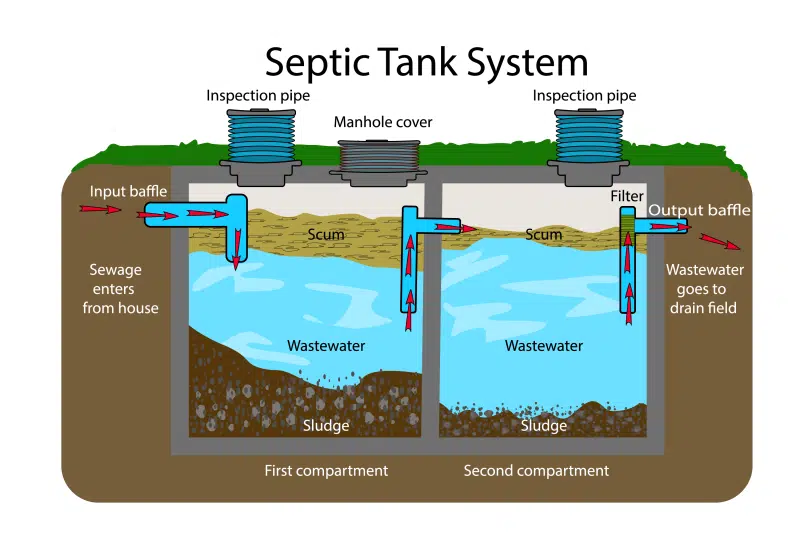
A functional septic system relies on five key components working together:

  1. Inlet Chamber: The inlet chamber is the first and largest section of the tank. Its primary purpose is to retain heavy solids—such as toilet paper, food waste, and feces—allowing them to settle at the bottom.
  2. Baffle Wall: This internal wall separates the inlet and outlet chambers. It features an opening at a specific middle depth, allowing only the clarified liquid—the layer between the floating scum and the sunken sludge—to pass through to the next chamber.
  3. Outlet Chamber: The second chamber provides additional time for any remaining fine solids to settle, further purifying the liquid before it exits the tank.
  4. Tank Outlet: The outlet is typically equipped with a vertical Tee-pipe. This design forces the exiting liquid to be drawn from below the floating scum layer. Because the top of the Tee sits above the water line, it prevents floating debris from entering the pipe and clogging the leach field.
  5. Leach field: The leach field consists of trenches roughly three feet deep, filled with a foot of gravel and a perforated pipe. As liquid flows from the tank, it spreads across the gravel and percolates into the soil. These trenches are covered with topsoil to prevent public exposure and ensure natural filtration. 

These components ensure that wastewater is treated and safely reintroduced into the environment. If any single part fails, it can lead to significant system-wide issues. 

How the SludgeHammer® System Helps

The SludgeHammer® transforms a passive, anaerobic septic tank into a high-performance, aerobic treatment plant. It aerates, circulates, and inoculates the entire tank using a fraction of energy—roughly the same amount required to power a single 50-watt lightbulb. Inside the unit, a sophisticated bioreactor environment is created. 

In a standard installation, up to 33,000 gallons of water per day circulate through 120 square feet of an inner, compacted matrix core. This specialized surface area allows massive colonies of robust, waste-eating microbes to attach and thrive, providing a level of treatment that a stagnant tank simply cannot achieve.

To learn more, check out our video on how the SludgeHammer wastewater management system can help your rural property. 

How Do You Maintain a Septic Tank?

Maintain a Septic Tank

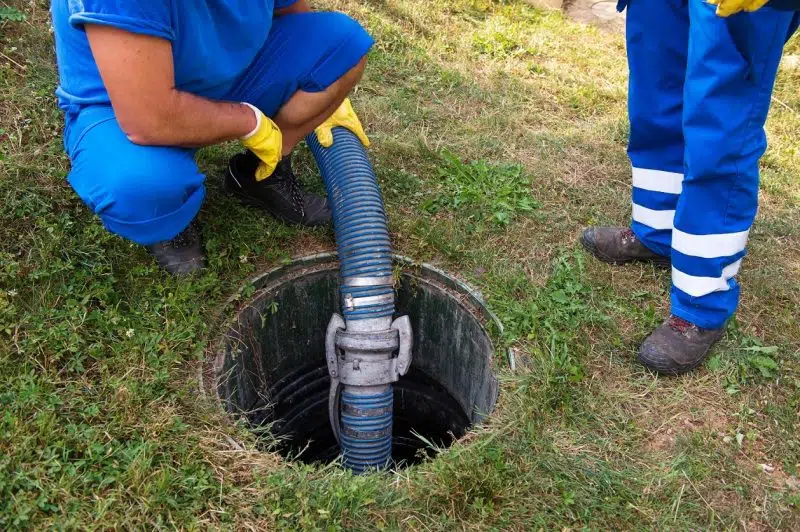
For standard septic tanks, the most critical maintenance task is professional pumping. A pump truck uses a high-powered vacuum and a 3-inch hose to remove both liquid and accumulated solids. It is recommended to pump your tank every 3 to 5 years, depending on household load. Waiting until the system fails is a dangerous game that often results in sewage backing up into the home.

Beyond pumping, maintenance is about what you do not put down the drain. “Flushable” wipes are notorious for clogging pipes. If it isn’t human waste or toilet paper, it does not belong in your septic system.

What Happens When a Septic System is Clogged?

The tank itself rarely clogs. Instead, failure typically occurs in the leach field trenches. Over time, the bottom of a trench may stop absorbing water, forcing liquid out the sides. Eventually, the liquid pools and fills the trench. When the liquid can no longer leave the tank, waste backs up into the house or spills onto the lawn—a foul, unsanitary situation.

Why Do Septic Systems Fail?

The primary cause of failure is biomat accumulation. In the human body, gut bacteria secrete mucus to protect themselves from stomach acids. In a septic tank, they produce even more to shield themselves from oxygen. This mucus becomes dissolved in the wastewater and flows into the leach field, creating a slimy, impermeable layer where the liquid meets the soil.

Other factors include:

  • Neglected Pumping: When sludge and scum layers grow too thick, solids like toilet paper enter and clog the leach lines.
  • Chemical Interference: Antibiotics, chemotherapy agents, excessive chlorine, or paint can kill the good bacteria in the tank, preventing proper waste separation.

Signs Your Septic System is Failing

Lush Green Grass: Unusually vibrant patches of grass over the leach trenches during dry weather.

  • High Liquid Levels: Opening the tank to find the water level higher than the outlet pipe.
  • Surface Seepage: Liquid or odors breaking through the soil in the yard.
  • Backups: The final stage of failure, where plumbing backs up into the home.

What to Do if Your Septic System is Failing?

The first step is typically to pump the tank and, if necessary, jet the leach lines to clear sludge. To provide a long-term solution, the SludgeHammer® system can be introduced.

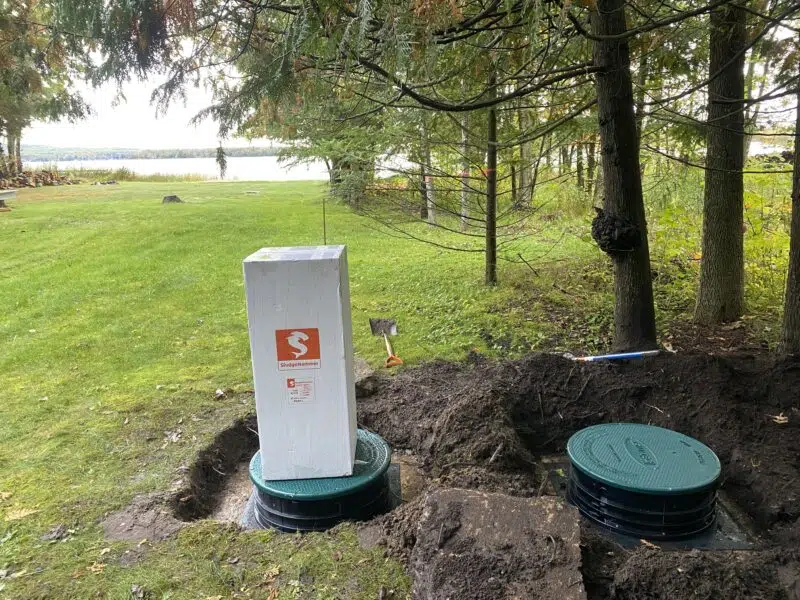
The SludgeHammer® ABG is installed in the first chamber and powered by a small, quiet 50-watt air blower. By introducing oxygen, the SludgeHammer Blend™ bacteria can flourish. These aerobic bacteria clean the liquid, eliminate odors, and travel into the leach field to consume the slimy biomat clogging the soil. While it cannot fix broken pipes, it can rejuvenate almost any field clogged by biomat.

What Makes SludgeHammer® Different?

What Makes SludgeHammer® Different?

Historically, the only way to fix a failed leach field was through a costly, destructive excavation. SludgeHammer® uses biology to solve a biological problem.

  • Non-Invasive: No heavy equipment is required, preserving your landscaping
  • Odor Elimination: By aerating the tank, it is no longer septic (anaerobic), which removes the source of foul smells
  • Water Recovery: The treated liquid is high enough quality to be used in sub-surface irrigation, effectively watering and fertilizing your landscape

The SludgeHammer® provides the oxygen and environment needed for bacteria to thrive, creating a steady supply of cleaners for your leach field. 

Protecting Your Property and the Environment

Understanding how your septic tank works is the first step in avoiding costly repairs and environmental hazards. While traditional systems rely on a delicate balance of anaerobic bacteria and soil absorption, they are inherently prone to biomat clogging over time. 

By shifting from a passive septic process to an active, aerated treatment solution like SludgeHammer®, you can extend the life of your leach field, eliminate foul odors, and ensure your household wastewater is processed safely and efficiently. Proper maintenance today prevents the unpleasant surprises of tomorrow.

Interested in becoming a SludgeHammer® installer? Visit our Become and Installer page for details!

SludgeHammer distributor

Frequently Asked Questions

Can I plant trees or shrubs near my leach field?

It is best to avoid planting trees or large shrubs within 30 feet of your leach field. Aggressive root systems are naturally drawn to the moisture and nutrients in the trenches, which can lead to cracked pipes and structural blockages. Stick to shallow-rooted grasses or flowers to keep the area stable without risking damage.

Does using a garbage disposal affect my septic system?

Yes. A garbage disposal significantly increases the amount of organic solids and grease entering the inlet chamber. This leads to faster sludge accumulation, meaning you will likely need to pump your tank more frequently (every 1–2 years instead of every 3–5) to prevent these solids from reaching the leach field.

Is it safe to use “septic-safe” household cleaners?

Most standard household cleaners are safe in moderation, but antibacterial products and heavy bleach should be used sparingly. These are designed to kill bacteria, and if they enter the tank in high concentrations, they can wipe out the microbial colonies responsible for breaking down waste, leading to system stagnation.

How does heavy rain or flooding impact my septic tank?

During periods of extreme rain, the soil in the leach field can become saturated, leaving no room for wastewater to percolate. This can cause the system to back up temporarily. It is important to divert North-facing gutters and surface runoff away from the leach field area to prevent hydraulic overloading.

Can I build a deck or parking pad over my septic tank?

You should never build permanent structures or drive heavy vehicles over any part of the septic system. Doing so can crush the pipes, collapse the tank, or compact the soil in the leach field, which destroys its ability to absorb water. Access manholes must always remain clear for inspection and pumping.


Posted in: Blog

The Silent Killer: How H2S Gas Destroys Concrete Septic Tanks

In the wastewater industry, we often focus on the leach field. We worry about clogging, biomat, and hydraulic loading. But for many residential and commercial properties, an unexpected danger is working from the inside out, eating away at the very infrastructure designed to hold the waste: H2S gas in concrete septic tanks.

If you are a septic installer, pumper, or property manager, understanding this chemical onslaught is vital. It isn’t just about a foul odor. It’s about the structural disintegration of a multi-thousand-dollar asset.

The Chemistry of Decay: From Gas to Acid

Traditional septic systems are anaerobic (oxygen-free) environments. In these conditions, sulfate-reducing bacteria break down organic matter and release hydrogen sulfide (H2S) gas.

While the rotten-egg smell is a primary indicator of hydrogen sulfide, the real septic tank damage occurs in the air gap between the liquid level and the tank lid (headspace).

Here is the step-by-step process of how H2S destroys concrete:

  1. Gas Accumulation: H2S gas rises out of the wastewater and settles in the headspace.
  2. Moisture Interaction: The gas dissolves into the condensation clinging to the concrete walls and the underside of the tank lid.
  3. Acid Conversion: Sulfur-oxidizing bacteria (such as Thiobacillus) consume the dissolved H2S and excrete sulfuric acid.

Concrete is alkaline by nature, while sulfuric acid is highly acidic. When the two meet, the acid eats through the calcium hydroxide in the concrete, turning the hard surface into a soft, crumbly mush known as gypsum.

The Telltale Signs of H2S Damage

Because this process occurs above the waterline, it often goes unnoticed during routine pump-outs unless the technician knows what to look for. Over time, the results are catastrophic:

  • Spalling and Flaking: The tank’s interior surface begins to peel away in layers.
  • Exposed Rebar: As the concrete disappears, the steel reinforcement becomes exposed to the acid. The steel then rusts and expands, further cracking the concrete.
  • Baffle Failure: Concrete baffles are often the first to go. When a baffle fails due to H2S corrosion, solids bypass the tank and head straight for the leach field, causing a total system failure.
  • Structural Collapse: In advanced stages, the tank lid becomes so thin that it can no longer support the weight of the soil above it—or a vehicle driving over it.

The SludgeHammer® Solutions: Prevention Through Aeration

For years, the industry’s only answer was to apply expensive epoxy coatings or plastic liners to the interior of tanks. These are difficult to apply to existing systems and are prone to peeling. That’s why SludgeHammer® offers a better approach: we eliminate the gas before the acid can form.

By retrofitting a concrete tank with the SludgeHammer® Aerobic Bacteria Generator (ABG), you fundamentally alter the system’s environment. SludgeHammer® vigorous aeration process creates an aerobic environment where hydrogen sulfide can’t be produced. Instead of just treating waste, you are actively preserving the concrete infrastructure.

H2S Gas in Concrete Septic Tanks: Stop Corrosion Before it Starts

Hydrogen sulfide isn’t just a smell issue—it’s a structural liability quietly shortening the lifespan of concrete tanks from the inside out. By the time spalling, exposed rebar, or failing baffles are visible, the damage is already expensive. 

With the help of SludgeHammer®, you can stop the hydrogen sulfide septic tank damage before it starts. No gas, no acid, no chemical erosion messing with your system’s infrastructure. Just a long-term, cost-effective solution. 

If you’re ready to restore and prolong the lift of your septic system, contact SludgeHammer® today! 


Posted in: Blog

RV Park Septic System Problems & How to Solve Them Without Excavation

When your RV park is facing a failing septic system, you’re looking for so much more than just a repair. You’re looking for a way to save your season with a solution that fixes the problem in days without tearing up your landscaping. 

Campgrounds present one of the toughest challenges when it comes to septic system problems. Between surge loads from holiday weekends and the chemical-heavy nature of high-strength wastewater in RV parks, traditional systems often don’t stand a chance.

As a campground owner, you know the challenges, but let’s look at five common wastewater nightmares for RV parks and how you can solve them without disturbing your land or your season.

1. The “Sunday Surge” Overload

The Nightmare 

In a typical RV park, wastewater flow isn’t a steady stream—it’s a flood. On Sunday mornings, dozens of rigs dump their 40- to 60-gallon holding tanks simultaneously. This hydraulic surge pushes solids out of the septic tank and directly into the leach field, leading to rapid septic system problems at campgrounds. 

The Non-Invasive Solution

Instead of digging up the yard to install massive, expensive surge tanks, SludgeHammer®’s Aerobic Bacteria Generator (ABG) can be retrofitted into existing tanks. This technology uses vigorous aeration and a proprietary bacterial blend to process waste at 4 to 5 times the rate of a standard system, allowing the existing infrastructure to handle those weekend peaks without the need for expansion.

2. High-Strength Wastewater Kill-Off

The Nightmare

RV wastewater isn’t like residential waste. It is often packed with formaldehyde, quaternary ammonium, and other holding-tank deodorizers designed to kill bacteria. This creates high-strength wastewater that shuts down the natural biological processes in a standard septic tank. 

The Non-Invasive Solution

SludgeHammer® doesn’t rely on luck when it comes to bacteria. These systems continuously inoculate the tank with a hardy, proprietary bacterial blend specifically designed to thrive in harsh environments. This ensures the system stays biologically active even when guests use aggressive chemicals.

3. Biomat Clogging

The Nightmare

When a system is overloaded with organic matter, a thick, slimy layer called biomat forms at the soil interface of the leach field. This slime acts like a waterproof liner, preventing water from percolating. Once this happens, the system fails, sewage surfaces, and the health department shows up. 

The Non-Invasive Solution

Conventional wisdom says you have to dig up and replace the field. SludgeHammer®, on the other hand, says you just need to change the chemistry. Our aerobic microbes travel out into the leach field, where they actually consume the biomat. By converting the field back to an aerobic state, we restore the soil’s natural absorption capacity—zero digging required.

4. Limited Real Estate for Expansion

The Nightmare

Many parks want to add more sites, but are restricted by their current septic capacity. Local codes often require a massive footprint for a traditional leach field expansion, which means sacrificing profitable RV sites to make room for more gravel and pipe. 

The Non-Invasive Solution

SludgeHammer® is a scalable solution. Because our treated effluent is significantly cleaner (Class 1 quality), many jurisdictions allow for a reduced dispersal footprint. With this advanced septic technology, you can maximize your land use, turning what would have been a leach field expansion into three or four new revenue-generating RV pads.

5. Toxic Odors Ruining the Guest Experience

The Nightmare

Nothing kills a 5-star review faster than the smell of raw sewage wafting through a picnic area. Odors are a sign of anaerobic (oxygen-starved) conditions where hydrogen sulfide gas is produced. 

The Non-Invasive Solution

SludgeHammer® units eliminate odors at the source. By introducing oxygen and specialized microbes, we shift the tank from anaerobic to aerobic. The result? A system that is virtually odorless. 

What Makes SludgeHammer® a Great Choice for Your RV Park?

For campground owners, the traditional dig and replace model is time consuming, expensive, and often weather-dependent. By working with a SludgeHammer® dealer, you get a system that is:

  • Easy to Install: A typical commercial unit can be installed in a few hours into an existing tank.
  • Highly Scalable: The modular design means you get a solution for 10 sites or 500 sites using the same core technology.
  • Low Maintenance: With no complex mechanical parts (only a simple linear blower), you’ll need fewer service and maintenance calls.

The Bottom Line: Protecting Infrastructure and Income

Solving campground septic system problems doesn’t have to mean shutting down your park for a month of excavating and reclamation. With SludgeHammer®, you get a service that’s faster, cleaner, and more effective at treating high-strength wastewater in RV parks. 

As a park owner, you get to save your property, reputation, and season. If you’re ready to simplify your RV park septic system operations, contact SludgeHammer® today! 


Posted in: Blog

Septic System ROI Analysis : How a SludgeHammer® Upgrade Lowers Lifetime Costs

In the septic industry, the knee-jerk reaction to a failing system is often a full replacement. You know the drill: bring in the heavy machinery, tear up the customer’s landscaping, and spend days on a high-overhead project. But what if you could solve the customer’s problem in a single afternoon, protect your crew from callback fatigue, and significantly pad your bottom line?

Lucky for you, we’ve conducted a septic system ROI analysis to help you make the shift from a dig-and-replace model to a repair-and-retrofit method. With SludgeHammer®, you’re not just fixing a tank—you’re optimizing your business for higher gross margins and long-term scalability. Let’s dive in.

The Margin Math: Why Retrofits Outperform Replacements

Most septic installers hope to achieve a net profit margin of 10% to 20%. While a full $20,000 system replacement looks like a win on paper, the high costs of labor, heavy equipment, and materials often thin those margins out.

When you perform a septic system ROI analysis on a SludgeHammer® retrofit, the numbers tell a different story:

  • Lower Overhead: No excavators, no dump trucks, and no destroyed driveways.
  • Faster Turnaround: A SludgeHammer® unit can often be installed in a few hours. This allows your team to complete multiple jobs in the time it takes to finish one traditional replacement.
  • Higher Gross Margin: By offering a high-value, proprietary biological solution, you shift from being a commodity contractor to a specialized technology provider.

Repair, Don’t Replace – A Powerful Sales Tool

Homeowners are often terrified by the cost of a new leach field, which can cost upwards of $20,000, depending on the site. When you present the SludgeHammer® option, you aren’t just selling a product—you’re providing a financial lifeline.

When you lean into the repair, don’t replace mindset, the conversation shifts from sticker shock to long-term value. Instead of focusing on the upfront price, you’re highlighting what really matters—protecting their yard, their budget, and their peace of mind.

That approach builds trust right away and shortens the decision cycle, especially for customers who feel stuck or overwhelmed by the high cost and disruption of full excavation.

SludgeHammer®: The Solution That Cuts Callbacks

Callbacks are the silent profit-killers of the septic world. A traditional repair might fail if the underlying biomat issues aren’t addressed, leading to frustrated homeowners and unpaid service visits.

SludgeHammer®’s patented ABG technology works by introducing a robust blend of aerobic bacteria that actively consume the biomat clogging the leach field. Benefits of this system include:

  • Low Maintenance: With only one moving part (an above-ground air blower), there is very little that can go wrong.
  • Self-Regulating: Our biological blend adapts to the load, meaning fewer calls about sluggish drains or surfacing effluent.
  • Set it and Forget it: A system that works as advertised means your crew stays focused on new revenue-generating installs rather than revisiting old jobs.

In a competitive market, differentiation is everything. Carrying a product that is IAPMO/UPC-certified for retrofits gives you a decision stage advantage your competitors don’t have. You can offer a solution for “un-fixable” sites where traditional replacements are physically or legally impossible.

Build a Smarter, More Profitable Septic Business

Becoming a SludgeHammer® installer isn’t just adding a product line—it’s an upgrade to your entire business model. Traditional septic repair tethers you to heavy equipment, volatile fuel costs, and razor-thin margins. With SludgeHammer®, you trade the excavator for a high-efficiency biological solution that delivers stronger gross profits and fewer time-draining callbacks.

While your competitors are tearing up lawns and losing days to site prep, you’re delivering a non-invasive, permanent fix in a fraction of the time. When you provide a septic system ROI analysis to your clients, the value becomes undeniable: they save tens of thousands in landscaping and replacement costs, while you secure a higher-margin project with significantly less overhead.
Ready to become a SludgeHammer® installer? Contact us today!


Posted in: Blog

Replacement vs. IAPMO/UPC Retrofit: Repair, Don’t Replace Failing Septic Systems

In the septic business, when a system begins to fail, the knee‑jerk reaction is often replacement: dig it up, haul it out, and put in a new tank and drain field. But that traditional replacement model comes with significant costs, extended timelines, and disruptive excavation that can slash your margins and frustrate homeowners.

There is a better way—one that keeps landscaping intact, reduces labor hours, and delivers certified performance without a full rebuild. Enter IAPMO/UPC retrofit solutions using SludgeHammer® Aerobic Bacterial Generators (ABGs)—a retrofit‑ready option that modernizes existing systems from the inside.

Traditional Replacement: Time, Cost & Turf Disruption

When septic systems fail, many installers know the pain:

  • High Replacement Costs: For homeowners, replacing a buried septic system can cost tens of thousands of dollars due to excavation, tanks, piping, and labor.
  • Long Project Timelines: Excavation, permitting, installation, and restoration slow down project cycles and delay revenue recognition.
  • Turf and Landscaping Damage: Breaking ground deep into properties tears up lawns, driveways, gardens, and hardscapes—leading to extra restoration work and unhappy customers.

This traditional approach often requires heavy machinery, longer scheduling windows, and elevated budgetary risk for your client.

IAPMO/UPC Retrofits: The SludgeHammer® Advantage

Rather than ripping everything out, SludgeHammer® ‘s IAPMO/UPC-certified retrofit solutions transform existing septic tanks into high‑performance treatment systems. This approach is proven to save time and money while preserving landscaping.

Unlike full replacement, retrofit solutions:

  • Don’t Require Excavation (in most cases): retrofits are installed in the existing tank with minimal site disturbance.
  • Provide Faster Installation and Return to Service: SludgeHammer® ABG systems  typically install in hours versus days or weeks.
  • Result in Fewer Customer Objections: Less visible disruption means fewer complaints and more referrals.

Certified to Rigorous Industry Standards

SludgeHammer® stands out in the retrofit category because its products are certified under trusted codes, including:

  • IAPMO Standard IGC180‑2003 retrofit certification — verifies proven performance in restoring failing septic systems through biomat management.
  • UPC® listing (Uniform Plumbing Code) — confirms compliance for installers across the U.S. and Canada.

These certifications matter when convincing local health departments or other authorities that your retrofit solution is not a “band‑aid,” but a code‑approved approach that exceeds regulatory expectations—especially where approvals hinge on recognized standards.

With certified retrofit systems, you can confidently propose them as a compliant, proven alternative rather than a full replacement.

Performance & Installer Benefits

SludgeHammer® ABG systems, like the S‑46 model:

  • Enhance organic digestion and break down biomat more effectively than aerobic systems alone.
  • Restore failing leach fields without excavation.
  • Extend the lifespan of existing infrastructure and reduce long‑term maintenance calls.

For installers, this translates to:

  • Reduced labour and equipment costs
  • Quicker job turnaround and earlier payments
  • More satisfied clients with intact landscaping
  • Differentiation from competitors still pushing expensive replacements

Ready to Grow Your Business as a Certified Installer?

SludgeHammer® isn’t just another product to stock—it’s a proven way to expand your service offering, shorten project timelines, and close jobs that would otherwise stall or be lost to full replacement.

Our certified installer program equips septic professionals with the training, technical support, and regulatory-validated retrofit technology that’s already being approved, specified, and installed in the field.

As an authorized SludgeHammer® installer, you can:

  • Add certified, code-recognized retrofit solutions to your services
  • Win more work by offering a lower-cost, low-disruption alternative to replacement
  • Position your company as a trusted, forward-thinking partner to homeowners, engineers, and health departments

When the choice between replacement vs. IAPMO/UPC retrofit comes up, position yourself in the best possible way. Grow your revenue, reduce your risk, and stand out in a competitive market by becoming a SludgeHammer® installer.
For more information and to apply, contact SludgeHammer® today!


Posted in: Blog

Fixing Biomat Clogging: A Non-Invasive Septic Drainfield Solution for Professionals

In the wastewater industry, we often see a familiar pattern: a homeowner calls about surfacing effluent, sluggish drains, or foul odors. Traditionally, the diagnosis is a “failed” drainfield, and the standard prescription is a total system replacement costing tens of thousands of dollars.

However, for professionals looking to provide more efficient, sustainable, and cost-effective services, the real culprit is usually biomat clogging. Understanding how to remediate this biological barrier—without the need for heavy machinery or excavation—is a groundbreaking solution for modern septic management. 

If you’re looking to expand your service offering and provide a high-margin, low-disruption alternative to excavation, it’s important to first understand the science of biomat clogging. Let’s have a look. 

What Is Biomat and Why Does It Matter?

In the industry, we often call it the “limiting zone.” Biomat is a dense, jelly-like layer of anaerobic bacteria, specialized microorganisms, and organic matter that develops at the soil-to-trench interface.

Contrary to popular belief, biomat isn’t inherently a sign of failure—it is actually a critical component of the treatment process. In a balanced system, a thin, permeable biomat layer acts as a final biological filter, stripping out viruses and pathogens before the effluent reaches the groundwater.

The problem arises when the system’s oxygen demand exceeds its supply. As the soil interface becomes oxygen-depleted, an anaerobic environment takes over. In these conditions:

  • Polysaccharides Build Up: Anaerobic microbes produce a thick, waterproof “slime” (polysaccharides) that seals off the soil’s natural pores
  • Infiltration is Reduced: What was once a permeable filter becomes an impermeable barrier
  • Systems Back Up: This septic drainfield clogging creates a biological dam. When the effluent can no longer move through the limiting zone into the underlying soil, it’s forced to pond in the trenches, eventually surfacing in the yard or backing up into the home

For the septic professional, the goal isn’t necessarily to eliminate biomat entirely, but to manage its thickness and permeability to prevent biomat clogging.

Common Field Symptoms and Diagnosis

As an installer or service provider, recognizing the difference between a mechanical failure and a biological one is key to a correct diagnosis. Look for these professional-level indicators:

  • Hydraulic Loading in the Trench: Poking a probe or inspection port reveals standing water in the gravel or chambers, despite the soil being theoretically permeable.
  • The “Black Slime” Indicator: When excavating a small test pit, the soil interface is coated in a distinctive, dark, anaerobic sludge.
  • Sluggish Bio-Maturation: Slow-draining fixtures throughout the home, even after the tank has been recently pumped, often point to a restricted soil interface.
  • Persistent Odors: The presence of hydrogen sulfide (rotten-egg smell) around the drainfield suggests that the system has turned anaerobic and is no longer processing effluent correctly.

Confirm the Root Causes Before Treatment

Before recommending a solution, ensure the failure is biological. Biomat clogging is the primary culprit in 95% of cases, but as a professional, you must first rule out:

  • Crushed Pipes: Use a camera inspection to ensure structural integrity.
  • Hydraulic Overload: Confirm the system isn’t being flooded by leaking toilets or groundwater intrusion.
  • Sodium Binding: Ensure the soil chemistry hasn’t been destroyed by water softeners (common in clay soils).

Once these are ruled out, you are looking at a biological failure that is perfectly suited for SludgeHammer® remediation.

Where SludgeHammer® Fits In 

Instead of “dig and replace,” SludgeHammer allows you to “treat and restore.” Our technology transforms the existing septic tank into a high-performance bioreactor.

  • SludgeHammer Blend™ Bacteria: This isn’t a grocery-store additive. It’s a concentrated consortium of robust, aerobic microbes designed to aggressively digest the 
  • nitrogenous compounds that form the biomat.
  • SludgeHammer S-86: This Aerobic Bacterial Generator (ABG) is the professional’s heavy hitter. By fitting the S-86 into an existing tank, you provide the constant aeration and inoculation needed to send an “army” of aerobic bacteria into the drainfield. These microbes literally consume the biomat from the inside out, restoring soil porosity.

Cost & Impact Comparison

When discussing options with your customer, it’s important to understand how the different solutions for treating biomat clogging stack up. Let’s take a look. 

FeatureSludgeHammer®Excavation & System Replacement
InvasivenessNon-invasiveHighly invasive 
Total CostSignificantly lower than replacement and comes with higher margins for pros.Expensive for providers and clients. Includes high labor and material overhead.
Property ImpactMinimal—no heavy machinery or landscaping repair.Heavy disruption—destroyed lawns, trees, and driveways requiring remediation and restoration.
Time to CompleteA few hours for installationMultiple days of site work
PerformanceCertified to restore drainage at least 2.5x faster.Resets the clock, but doesn’t prevent future biomat.

Battle Biomat Clogging the Smart Way: Become a SludgeHammer® Installer

The future of the wastewater industry is moving away from massive earth-moving projects and toward targeted, biological solutions. Make biomat clogging a thing of the past for your customers. By carrying and installing SludgeHammer® products, you can save your customers thousands of dollars while expanding your service offering and maintaining a highly profitable service model.

Stop digging up drainfields that can be easily saved. Contact SludgeHammer® today to learn more about becoming a certified installer. 


Posted in: Blog

How to Become a SludgeHammer® Dealer: Step-by-Step Guide to Joining Our Network

Are you a wastewater pro looking to upgrade your business with the latest technology in septic treatment solutions? Becoming a SludgeHammer® dealer gives you advanced, certified treatment technology and the opportunity to become an industry leader in sustainable wastewater solutions.

SludgeHammer® products are transforming the septic and wastewater space, and dealers are at the heart of that revolution. In this blog, we’ll walk you through how to become a SludgeHammer® dealer, from certifications and qualifications to benefits and success tips.

Why Partner with SludgeHammer®?

SludgeHammer® is not just another septic product—it’s a proven, certified, advanced treatment technology that stands out for performance, environmental compliance, and innovation.

Here’s what makes this partnership worth it:

  • Industry-Recognized Certifications: SludgeHammer® products meet stringent standards like NSF/ANSI, IAPMO, and MARPOL MEPC-159 
  • Advanced Retrofit Technology: Our patented biological treatment systems are engineered to rejuvenate existing septic infrastructure, restoring leach fields and extending system life with minimal disruption
  • Global Reach and Support: From residential and commercial systems to industrial and marine applications, SludgeHammer® products are designed for diverse uses, creating opportunities for dealers in a range of markets

When you partner with SludgeHammer®, you’re doing more than selling a product—you’re joining a future-focused network built on continuous training, advanced techniques, and real-world performance. 

Our Ideal SludgeHammer® Dealer

Before you get too excited, let’s look at who SludgeHammer® is looking for in its dealer network. Ideal candidates typically: 

  • Are an established wastewater, plumbing, excavation, or related operation 
  • Hold relevant licensing, qualifications, and certifications in their respective fields
  • Have a strong reputation for quality work and outstanding customer service 
  • Understand onsite wastewater systems, from newly engineered designs to aging system management
  • Are committed to completing SludgeHammer®’s installation and maintenance certification

If you or your team thrives on professional excellence and sustainable solutions, we’d love to hear from you! 

How to Become a SludgeHammer® Dealer

Step 1. Evaluate Your Qualifications

Review your business credentials — licenses, certifications, service history, and technical expertise in septic or wastewater systems to ensure you meet the criteria. 

Step 2. Contact SludgeHammer® and Submit Your Info

Head to the SludgeHammer® installer page and complete the form, providing your company details and region of operation. A team member will respond to start the onboarding process. 

Step 3. Complete Certification Training

Once your initial application is accepted, you’ll go through SludgeHammer®’s complementary (Zero Charge) certification program—covering installation, maintenance, product specifics, and troubleshooting. Formal training ensures you’re fully equipped to represent and install our technology.

Step 4. Meet Any Regional Requirements

Depending on your location, additional permits or compliance steps (e.g., local health department approvals) may be necessary once you’re certified. Certified installer status often plays a key role in regulatory acceptance. 

5. Start Installing & Supporting Customers

After certification, you’re ready to install SludgeHammer® systems and provide ongoing maintenance. You’ll also have access to support materials and resources to help you succeed. We’re with you every step of the way! 

Why Become a SludgeHammer® Dealer

Joining SludgeHammer’s network isn’t just a credential—it’s a business advantage:

Grow Your Service Offering 

With SludgeHammer®, you add advanced treatment systems to your portfolio, helping you stand out from the competitors who typically rely on traditional solutions. 

Earn Client Trust

Certified systems demonstrate adherence to industry standards and environmental best practices, often valued by today’s home and business owners. 

Access to Ongoing Resources & Support

Dealers receive technical guides, marketing resources, and direct support to help them grow sales and service excellence.

Tap into a Growing Market

As environmental standards tighten and demand for sustainable wastewater solutions rises, certified dealers are positioned for long-term demand.

It’s Time for You to Consider Becoming a Certified SludgeHammer® Dealer

When it comes to the question of how to become a SludgeHammer® dealer, the answer is simple when you follow the steps and speak to one of our teammates. The decision to get on board is a strategic move for wastewater professionals ready to expand their service offerings with certified, advanced treatment solutions. With the right preparation, training, and commitment to quality, you can join a network that’s shaping the future of septic and wastewater performance.
Ready to take the next step? Contact SludgeHammer® to get started today!


Posted in: Blog

Certified, Not DIY: Warranty-Backed Wastewater Installation by Certified Professionals

When it comes to wastewater treatment, when you cut corners, you’re not just risking poor performance—you’re also risking regulatory failure, serious environmental damage (and the consequences that come with it), and costly do-overs. But still, many property owners and facility managers are tempted by DIY wastewater solutions they find online.

When it comes to installation for septic professionals and municipalities alike, the difference is clear: certified wastewater system installation isn’t optional—it’s essential.

The Problem with DIY Wastewater “Solutions”

When it comes to DIY wastewater installations, a quick online search will bring up countless “solutions” that promise successful results with minimal effort. Unfortunately, that’s rarely the reality.

Most DIY wastewater solutions suffer from the same critical shortcomings:

  • No third-party certification (NSF, IAPMO, or regulatory validation)
  • No installation standards—systems are often misapplied or improperly configured
  • No warranty coverage if performance falls short
  • No professional accountability when compliance issues arise

Without proper certified installation, even proven technologies can underperform. It’s essential that wastewater systems are installed, configured, and commissioned correctly to meet their tested treatment performance. Any deviation, common with DIY system installs, can void certifications and warranties entirely.

Why Certified Installation Matters

Wastewater systems aren’t consumer products—they’re regulated treatment infrastructure.

A certified wastewater system installation ensures that:

  • The system is installed exactly as tested and approved
  • Treatment performance meets regulatory expectations
  • Local codes and health authority requirements are satisfied
  • Long-term operation and maintenance are properly supported

Certified installers understand the nuances and requirements for wastewater system installation, including:

  • Hydraulic loading
  • Biological startup
  • System sizing
  • Site-specific conditions

These are all factors that DIY solutions tend to ignore, which is precisely why SludgeHammer® systems are not sold as DIY kits.

The SludgeHammer® Difference: Certified Installers Backed by Real Warranties

SludgeHammer® takes a professional-first approach to wastewater treatment—because performance and compliance are non-negotiable.

Certified Installer Network

SludgeHammer® systems are installed exclusively by trained, approved professionals who receive regular technical training on system design, biological principles, startup procedures, and long-term operation.

Warranty-Backed Wastewater Systems

Unlike DIY products, SludgeHammer® installations are supported by warranties that cover our products. This protection provides peace of mind to municipalities, engineers, and facility owners—while protecting installers from misapplied or unsupported systems.

Built to Meet Certification Standards

Proper installation is essential to maintaining certifications such as IAPMO compliance. SludgeHammer® installer requirements align with IAPMO installation principles, ensuring systems perform in the field as they did during testing.

Why This Matters for Septic Companies

For septic and wastewater professionals, certified installation isn’t a limitation—it’s a competitive advantage.

By offering warranty-backed wastewater systems, installers can:

  • Differentiate from low-cost, uncertified competitors
  • Reduce callbacks, failures, and liability
  • Build trust with regulators and municipal clients
  • Deliver measurable, documented treatment performance

Instead of competing on price with online DIY products, SludgeHammer® installers can compete on results, credibility, and long-term value.

Certified Systems Protect Everyone

At the end of the day, wastewater treatment isn’t the place for shortcuts. With certified wastewater system installation backed by warranties:

  • Communities are protected from environmental and compliance risk
  • Facility owners are safe from costly system failures
  • Installers avoid unnecessary liability
  • Waterways are safeguarded from under-treated discharge

Become a Certified SludgeHammer® Installer

As demand grows for reliable, compliant, and sustainable wastewater solutions, certified professionals are more important than ever.

If you’re ready to offer certified wastewater system installation with the confidence of warranty-backed wastewater systems, SludgeHammer® is looking for you.

To learn more about becoming a certified installer and start delivering wastewater solutions that stand up to any challenge, contact SludgeHammer® today! 


Posted in: Blog

How SludgeHammer® Delivers a Net-Zero Wastewater System for Communities

Wondering why net-zero matters when it comes to wastewater? Sustainability targets are no longer just abstract policy goals. Over time, they’ve become real-world requirements for municipalities, regulators, and infrastructure providers. In wastewater, net-zero means balancing what’s discharged into the environment with what’s safely reused, while minimizing energy consumption, emissions, and residual waste. 

In this blog, we’ll look at how the SludgeHammer® net-zero wastewater system helps communities across the globe reach these goals, and how you, as an installer, can leverage this advantage. 

Global Sustainability Targets

The United Nations Sustainable Development Goals (SDGs) outline the global standard for sustainability. When it comes to wastewater, SDG 6 (clean water and sanitation) and SDG 13 (climate action) apply to tighter nutrient limits, carbon-reduction mandates, and increasing pressure to do more with aging systems and limited budgets. 

Traditional wastewater treatment often works against these goals. High-energy mechanical aeration, frequent sludge hauling, and costly plant expansions consume resources instead of conserving them.

This is where SludgeHammer® technology stands apart—by enabling communities to move toward a net-zero wastewater system using biology-first treatment and retrofit-ready design.

The Net-Zero Challenge for Communities

Across North America, municipalities face a familiar set of issues: 

  • Aging wastewater infrastructure is nearing capacity
  • Rising energy costs are tied to aeration and pumping
  • Stricter discharge limits for nutrients like nitrogen and phosphorus
  • Limited capital budgets, especially in small and rural communities

For many towns, full system replacement just isn’t feasible. Instead, the most realistic path to net-zero wastewater performance is to retrofit existing systems to improve treatment without major disruption to the system. 

It may be a challenge for many, but it creates a unique opportunity for septic system installers and wastewater professionals who can offer proven, upgrade-based solutions. 

How SludgeHammer® Supports Net-Zero Performance

SludgeHammer® systems are inherently designed around the core principles of net-zero wastewater treatment: low energy input, minimal waste output, and maximum reuse potential. We support these through:

Biological Foundation

At the core of every one of our net-zero wastewater systems is the SludgeHammer Blend™, a proprietary microbial blend that accelerates natural digestion processes. By increasing biological activity, rather than relying on mechanical force, we can speed up treatment in a substantially more efficient way. 

Retrofit-Ready Design

SludgeHammer® systems convert existing septic tanks into advanced treatment systems—no demolition or rebuild necessary. This makes them ideal for municipalities and facilities that need upgrades, not overhauls.

Energy-Efficient Hardware

The SludgeHammer® system runs on the equivalent energy of a single light bulb. Compared to traditional aeration-based septic systems, it dramatically reduces operating costs and carbon footprint.

Closed-Loop Cycle

Effluent treated to high secondary standards can be safely reused for irrigation, groundwater recharge, and other non-potable uses, keeping water local while reducing discharge volumes.

Reduced Sludge Hauling

Enhanced digestion means less residual sludge, fewer pump-outs, and less trucking. That translates directly into lower emissions and lower lifecycle costs.

Certified Performance. Proven Compliance.

Performance matters—especially for regulators, engineers, and municipal buyers. SludgeHammer® technology is backed by independent testing and internationally recognized certifications, including: 

  • NSF/ANSI 40 Class 1 certification
  • IAPMO IGC 180-2003 compliance
  • MARPOL certification is the global benchmark for marine discharge standards

SludgeHammer® systems have also been validated by regulatory bodies such as Michigan EGLE, providing scientific and regulatory confidence for real-world deployment. 

Real-World Impact: Proven in the Field

Need more proof? SludgeHammer® systems are already delivering measurable results in demanding applications across the globe: 

  • SludgeHammer® helped Pond Hill Farm reduce its nutrient runoff, helping it to protect surrounding waterways while maintaining agricultural operations
  • With SludgeHammer®, Reichardt Duck Farm resolved chronic waste pond issues and safely reused treated water on-site

Environmental and Economic Benefits

For communities, the SludgeHammer® system offers a rare combination of sustainability gains that also make financial sense. 

  • Lower capital and lifecycle costs compared to new infrastructure
  • Reduced energy use and emissions
  • Extended lifespan of existing treatment systems
  • Easier alignment with ESG reporting and climate targets

For septic installers, this translates into a solution that solves municipal problems without competing solely on price. 

Net-Zero Wastewater Systems: A Growing Opportunity for Septic Companies

As municipalities look for affordable ways to achieve net-zero wastewater goals, demand for retrofit-friendly, biologically-driven systems is rising. 

For septic professionals, offering the SludgeHammer® net-zero wastewater system gives you access to proven certified technology that fits perfectly into decentralized and municipal markets, while helping your clients move towards their goals. 
Interested in becoming a SludgeHammer® installer or distributor? Contact SludgeHammer® today to discuss our partnership opportunities!


Posted in: Blog

The SludgeHammer® Difference: A Scientifically Tested Wastewater Treatment System

When it comes to wastewater treatment, proof matters. The SludgeHammer® system isn’t just another onsite septic treatment solution. It’s a scientifically tested wastewater treatment system backed by years of research, field validation, and third-party testing from industry experts who know what truly works. 

Why Expertise Matters

Any wastewater treatment system is only as good as the science behind it. That’s why SludgeHammer’s technology has been rigorously tested by PhDs, ANSI institutions, environmental engineers, and government regulators. This level of scrutiny ensures the system doesn’t just perform in a lab—it delivers consistent, reliable results in real-world conditions.  

Every element of the SludgeHammer process, from its patented aerobic bacterial generator to its oxygen-driven bioreactor design, has been engineered for measurable performance and long-term resilience. The result? Proven reductions in wastewater contaminants, lower maintenance demands, and predictable lifecycle outcomes. 

Tested & Validated by Experts

To ensure its quality as a scientifically tested wastewater treatment system, SludgeHammer has undergone independent third-party testing and regulatory validation at the highest levels. In 2025, the Michigan Department of Environment, Great Lakes, and Energy (EGLE) issued an official design manual validation

This validation recognizes SludgeHammer as a proprietary treatment technology that meets stringent performance and design standards under EGLE’s requirements. This endorsement underscores the system’s scientific credibility and regulatory compliance—a distinction achieved by only a few technologies in the onsite wastewater industry. 

Proven Results, Predictable Performance

Through real-world installations and long-term monitoring, we have effectively proven the SludgeHammer wastewater treatment system’s exceptional performance across a variety of conditions. Field data confirms:   

  • Consistent effluent quality even under heavy load
  • Improved system longevity through biologically active treatment 
  • Reduced need for costly replacements or major repairs 
  • Predictable performance backed by data

Backed by the Best

At SludgeHammer, it’s not just the technology that sets us apart—it’s the people behind it. Our system was developed, tested, and refined by some of the best minds in the field: PhDs in microbiology and environmental engineering, licensed professional engineers, and experts trusted by both state and federal regulators. Every claim we make is backed by real data—not marketing spin—so you can trust that our performance speaks for itself.

A Scientifically Tested Wastewater Treatment System You Can Count On

Choosing a wastewater treatment system is a big decision—one that impacts your safety, the environment, and your peace of mind. With SludgeHammer, you’re getting more than just a proven system. You’re choosing a scientifically tested wastewater treatment system built on solid science, independently validated, and approved by regulators. It’s a smarter, safer investment—and we’re here to help you understand every step of the process.
Want to learn more? Contact SludgeHammer—we’re happy to talk.


Posted in: Blog