About Us

SludgeHammer Group Ltd.’s mission is to help solve the world’s wastewater treatment problems by providing safe, environmentally appropriate, efficient, and effective microbial biotechnology for residential, community, industrial, and marine use.

Residential Wastewater Treatment

Septic and residential wastewater systems can fail when soil becomes clogged over time. SludgeHammer offers a cost-effective, low-maintenance, and sustainable solution to remediate and improve performance without the high cost of replacement.

Commercial Wastewater Treatment

Our commercial products are flexible and scalable to grow with your needs. These innovative products are environmentally conscious and efficient, allowing wastewater to be treated and safely reintroduced to the environment within days.

What is a Septic System?

Let’s explore what a septic system is and how it works. The earliest humans dropped their waste directly onto the soil around them.  There the bacteria in the soil digested the waste and returned the nutrients back to the vegetation.  But when we started living in cities, this did not work.  So privies came into being.  The direct human excrement went into holes in the ground, and when they filled up, they were buried, and a new one was dug.  When plumbing was developed, so people had a water supply in the house, the toilet was invented to use the water to wash the excrement away from the house.  At first, this just went to a large pit.  This was improved by creating a box underground that had an open bottom so it could leach away.  But these would clog pretty quickly with the slimy liquid.  In the 1800s, Jean Mouras designed the first septic tank, which received the waste and held the solids while the liquid then went to a leach pit and then finally, the leach pit was extended, so it was a long trench filled with gravel to disperse the liquid better.   

While this technology seems primitive, it works quite well.  The septic tank allows slow digestion of the solids and creates zones where the heavier solids sink to the bottom, and the more active material floats to the top because of gas given off in digestion.  The cleaner water in the center depth is discharged to the soil.  The tank was made more effective by adding a baffle wall that created an inlet chamber and an outlet chamber.  This allowed further clarification and better digestion and prevented solid particles from going out to clog the pipes in the leach disposal field.

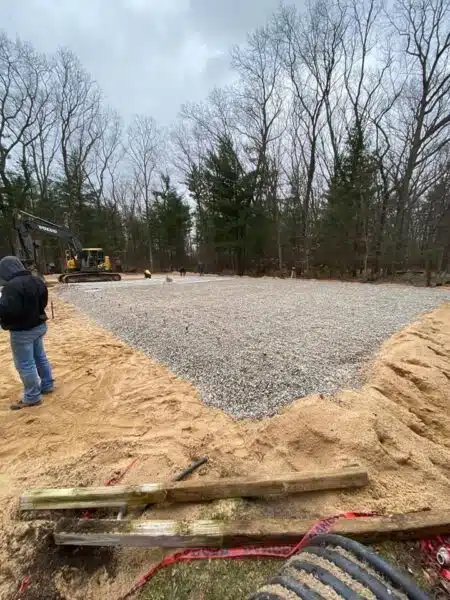
This leachfield is the ultimate “treatment” part of a septic system.  Organic digestion is seriously limited when no oxygen is available.  So even if bacteria are present, they can only partially digest organic carbon.  A leach field is typically a trough in the soil that is filled with about 18-24″ of drain rock and then covered with about 2 feet of soil.  This keeps potential disease-causing organisms underground and away from people.  The liquid from the tank is dispersed with a perforated pipe sitting on the gravel.  The void space in the gravel allows the water to quickly leave the tank and then be held for a longer time, so it slowly percolates out into the surrounding soil.  In the surrounding soil, bacteria and oxygen will be in the spaces between the grains.  These bacteria can use the oxygen in the air spaces to digest organic carbon to CO2.  CO2 is a gas that can escape into the atmosphere, leaving behind clean water that can keep percolating down to the aquifer.  These soil grains also filter out potential pathogenic bacteria and viruses as they pass through, protecting a homeowner’s well water.  

But consider this technology was developed when homes were widely spaced, and the population was lower.  A home needed to have well-drained soil, and it had to be in areas that did not have high groundwater.  As the population increased, the optimal properties were the first to be developed.  Over time these prime properties started to run out, and the neighborhoods with septics got more populous, and lots got smaller.  Now we are seeing groundwater under these denser communities start to be degraded by the nutrients from too many septic fields.  We have overstepped the capacity of a conventional septic system for protecting our environment. 


Posted in: Blog

How are Coagulants and Flocculants Used in Wastewater Treatment?

Coagulants and flocculants are used in wastewater treatment as a core concept for wastewater biotechnology. In most conventional treatment processes, the object is to get organic material out of water in a form that you can physically remove, by settling or filtering, and this is what coagulants and flocculants achieve. In this blog we will cover what the role of coagulants and flocculants are in wastewater, and why they are actually not the best option for wastewater treatment.

What are flocculants?

Flocculants are chemicals that cause materials in water to create flakes that can become large enough to settle to the bottom. The definition of flocculate means to cause materials to form into small clumps and masses, which is exactly what these chemicals do to the materials around them. In wastewater treatment, flocculants are things like polyacrylamide and other synthetic molecules.

What are coagulants?

Coagulants are chemicals that cause suspended particles to bind to each other and accumulate into gel-like materials that can be swept out of the water. These chemicals do exactly what they say, in that they cause materials to coagulate (change to a solid or semi-solid state). In wastewater treatment, coagulants can be minerals like aluminum sulfate, ferric chloride or organic amine groups or tannins.

Why are coagulants and flocculants used in wastewater treatment?

The first part of removing organic pollutants from wastewater is to get out all the large particles as quickly as possible.  This is done by settling.  Since the remaining material is dissolved, it won’t settle and cannot be filtered out. Therefore, bacteria are used to consume the dissolved nutrients, growing bacteria bodies in the process.  The bacteria convert a lot of this material into carbon dioxide through the digestion process so that part leaves the water as a gas. The residual, now consisting of bacterial bodies can be filtered out leaving behind clean water.  However, bacteria are too small to be directly filtered out.

How do coagulation and flocculation work together?

Flocculants are used first to cause these suspended bacteria to settle so they can be removed and sent to filters.  Once at the filter, the coagulants are added to agglomerate the material so that liquid can pass through the material when filter presses add pressure. Both are primarily used to concentrate compounds in wastewater so they can be removed from the water, leaving behind clean water. However, after all this complicated processing you are still left with sludge that is 80-90% water. This gets sent off to a landfill or is trucked away to plow into soil or left to sit. The central feature to the process of using coagulants and flocculants is inefficiency. The wastewater treatment process takes lots of energy, lots of chemicals, trucks, pumps, aerators, etc. and yet you’re left with a large amount of sludge that is unsafe to be reintroduced back to the environment. The use of coagulants and flocculants evolved back when the petroleum and petrochemical industries were King and chemical sales was big business.

How does the SludgeHammer make a difference compared to coagulation and flocculation?

SludgeHammer was created to put the bio back in biotechnology.  Because the industry was dominated by engineers and petrochemicals, nobody thought about finding species of bacteria that were suited by their very nature to more complete digestion of organic waste. Instead, we had systems built around random bacteria that came in willy-nilly into the system and didn’t worry about how effective they were because petrochemicals were cheap and abundant.  As a consequence, we have thousands of landfills sitting on billions of tons of rotting petrochemicals mixed with human sludge.

SludgeHammer has no use for coagulants or flocculants.  We introduce particular bacteria that are much better at absorbing and digesting the dissolved materials.  We also hold the bacteria in our bioreactor on surfaces that have the liquid passing over the bacteria 24/7.  The entire contents of a septic tank are circulated using air through our bacterial matrix over 20 times a day so everything is consumed in place.  There are no solids that have to be collected or removed on a daily basis. Our bacteria take care of this mess by efficiently converting organic carbon in waste into carbon dioxide in the atmosphere.  No muss, no fuss.

It’s time to stop using coagulants and flocculants in wastewater treatment. SludgeHammer processes are cleaner, more effective, and will save you time and money in the long run. Cleaning out the sludge of human waste after a coagulation can be a disgusting process, but SludgeHammer keeps your septic system running successfully so there’s no need to worry about the ‘unfiltered’ wastewater — there’s no such thing when you use a SludgeHammer. Contact us about how you can stop dealing with sludge and install a SludgeHammer today!


Posted in: Blog

The Power of Trees in Water Retention

“I think I shall never see a poem as lovely as a tree.” – Joyce Kilmer

The line above is from a rather trite poem by Joyce Kilmer that expresses her wonder of trees. Trees and forests are one of the most fascinating aspects of ecology. If you’ve spent time visiting or living among the Redwood trees in Northern California, it’s almost impossible to describe the awe-inspiring beauty found in these ancient forests. Everyone should visit the California coast from Eureka to Oregon to experience this natural wonder. 

Planting new trees is a great way to help reduce air pollution and begin a new cycle of life. There is, however, another equally important environmental initiative when it comes to trees: preserving the old ones. New trees are fantastic for providing oxygen, but trees in ancient groves do much more than that, they are vital for the preservation of freshwater.

Several years ago, a local, California landowner had filed a Timber Harvest Plan for a 40 acre ridge-top grove of virgin redwoods that were 1,000 years old.  The original owner had subdivided part of his property for homes several years back and had told all the residents that the grove was protected.  Unfortunately, after he died his children went against his wishes and were planning on selling the timber for a quick buck. Dr. Dan Wickham, SludgeHammer’s founder, was asked to intervene. He went through the county records and discovered that the property had never been properly protected through a legal order, so the neighbors were going to have a difficult road ahead to fight the desolation of this ancient grove.  

Luckily, they had Dr. Wickham on their side who looked into the issue further with a scientific lens to the protection and preservation of ancient groves.  

When the property had been subdivided it was approved conditionally to the availability of water.  In California water can be an issue because rain only falls in the winter, even though the north coast gets a lot of rain.  For six months of the year there is not a drop.  

This begs the question, how do redwoods survive such a long, annual drought?  The coast of California is unique.  The ocean is very cold because the winds push water offshore and it is replaced by deep cold water.  When warmer offshore air is drained it rises up the coastal ridge and condenses into fog.  Redwood needles are ideally shaped to create droplets from this fog, and they drop down to the soil as a gentle rain when it is foggy.  This lifesaving fog occurs in the summer so that the redwoods can create their own rain during the dry season.  The fog-rain can be a significant amount, up to 15 inches in a season.

The family’s proposal to cut the redwood grove down would actually eliminate much of the necessary freshwater that the family had guaranteed to the people who bought property in their development. With this knowledge behind them, the homeowners were able to get together and sue the Department of Forestry over the Timber Harvest Plan.  Dr. Wickham filed a deposition to the court that covered the Fog-Drip research and this important research was enough to persuade the judge that the THP had to address this issue in a full Environmental Impact Report.  The family that owned the grove chose instead to sell the land to the Sonoma Land Conservancy, where these 1,000 year old trees would be protected.  

The conservancy turned the grove into a local park. Dr. Wickham now finds himself about to wander through this grove of ancient towering trees with the satisfaction of having a hand in its continued existence.  


Posted in: Blog

Aerobic Bacteria and Wastewater Treatment

Bacteria are probably the least understood, and certainly least appreciated organisms on earth. Aerobic bacteria are organisms that can only survive (and thrive) in the presence of oxygen. In order to understand how aerobic bacteria work within wastewater treatment, we first need to dive into what bacteria are and how they work both in the body and in residential wastewater treatment.

Bacteria and the Body 

Humans seem to have an inordinate fear of these little guys, but, in many respects, we are just giant cargo ships for the thousands of species of bacteria that live in intimate association with us. Not only is our outside skin coated by hundreds of different types of bacteria, our insides carry over a thousand different species that do all kinds of jobs to keep us healthy. For us, the trick is to ensure that we have plenty of the “good” bacteria in and on us. “Good” bacteria are species of bacteria that act as the best defense we have against the few organisms out there that are actually dangerous. They consume dangerous bacteria and keep us healthy. 

It is no accident that taking a course of antibiotics can disrupt our intestines. Antibiotics kill off all the bacteria in your system, there’s no way to target just the bad bacteria, so the good bacteria in your system get killed off too.  Sometimes you can get pretty bad infections and there is no choice but to use antibiotics, but our society has completely gone over the top with its obsession with cleanliness. “Antibacterial” is omnipresent on our various cleaning products, but we need to be much more cautious about how we use these products.  

Gut Bacteria and Waste Treatment

Our waste is full of bacteria, so, naturally, a sewer line or septic tank will also be full of them. We use bacteria to treat that waste, but when we consider the types of bacteria in the waste, it becomes pretty clear that virtually none of them are the type of organism that would be suited to “treating” waste.  They are intestinal bacteria and when you think about where they live, inside warm-blooded animals, you realize they have some adaptations that make them probably the least suited for wastewater treatment.  

First, bacteria that live in our gut have spent their entire existence at 98.6o F.  When they hit the toilet, they literally go into temperature shock.  These bacteria can’t operate at normal ambient temperatures.  Second, these bacteria have co-evolved with us.  We give them a warm home, and, in exchange, the bacteria pre-digest our food for us.  They break large chunks down to smaller molecules that we can then absorb through our intestines.  In a waste treatment system, we want bacteria to digest the organic waste all the way down to CO2 so it can escape as a gas.  If they did that in your gut, not only would they be stealing your food, you would also be in constant pain from the gas.  So, these bacteria have evolved to have very delicate appetites and we can keep them on board.  Again, not what you want in a sewage digester.   

Finally, gut bacteria live in a soup of enzymes and acids, so they have to secrete a mucus coating to protect their cell membrane.  All bacteria do this, but gut bacteria secrete a lot more than other types of bacteria.  This mucus is a problem that makes everything slimy.  It goes out into the septic tank and then goes out into the soil where it clogs the pores.  Over time, the leach trench can no longer soak away the effluent and it comes to the surface, right in your back or front yard.  

Aerobic Bacteria in Nature

Gut bacteria are not ideal for waste treatment, they are only useful inside the body. There are, however, incredibly useful bacteria that can digest our wastes.  Most of them live in the soil.  The soil receives billions of tons of dead material every year in the form of leaves, grass, animal bodies, and any other organic material you can think of. These bacteria have big appetites, especially in temperate zones.  Think of what happens in the forest.  Each year during the summer, huge quantities of plant materials accumulate. The leaves fall to the ground and then are covered by snow.  Nothing really happens all winter but as soon as spring comes and the snow-melt moistens the soil, spores of bacteria start to germinate.  What happens is a race.  The first ones to emerge get a head start.  They grow by dividing and many of these species will divide every 30 minutes. The objective of these types of bacteria is to eat as much of the dead organic waste as possible, reproduce and use up the food, and then create spores to wait for the next year. The bacteria that do this the fastest win the evolutionary race.

There is another amazing feature in the ecology of these organisms.  They need oxygen, and typically get it from O2 in the air, these are called aerobic bacteria.  In the leaf litter you are also going to find the occasional pockets of space that are anaerobic, like a bunch of soaked leaves packed together, and there is no way for the bacteria to gather oxygen from the air.  This is a problem for what we call “strict” aerobes, bacteria that can only use O2 that they harvest from the air, but many species of soil bacteria are what we call “facultative” species.  They grow quickly with O2, that is harvested from the air, but if air and O2 is not available, they can get the oxygen they need from other compounds that have oxygen in their make-up, especially sugar molecules. The cellulose of the leaves is a long chain of sugar, and so is the mucus that causes problems in leach fields. The bacteria can break down these molecules to get the oxygen they need using the process of fermentation.  

Fermentation isn’t quite as efficient as aerobic digestion, but  half the carbons still get converted to CO2 and the rest become alcohols or esters, which are small molecules.  The slimy, long chain of mucus molecules disappear and clogged soil opens up.

SludgeHammer Uses Aerobic Bacteria for Waste Treatment

We created the SludgeHammer so we could grow some of the best of these soil species inside a septic tank.  If all you do is add the spores to the tank, the bacteria go into the anaerobic septic tank and never even germinate.  With the SludgeHammer, we provide the oxygen that these spores need to get started.  We also designed it so it would use the air to mix and pump the liquid in the septic tank through the column of the unit.  Inside the ABG, we engineered a fixed film growth matrix to provide a refuge for the bacteria to attach and form a robust colony.  The liquid entering the SludgeHammer carries with it the food that the bacteria need and, voila, the bacteria can grow in a septic tank.  

Now we can send these bacteria out into the soil and clear out the clog, no mess, no fuss.  Just biology working for us instead of against us. Aerobic bacteria are used to break down the waste to a point where the water can be safely reintroduced to the environment, and you never need to worry about your septic system getting clogged!

SludgeHammer products will help you get the best experience from your septic system. By installing a SludgeHammer, your septic system will be able to treat waste and wastewater more efficiently and effectively. If you want peace of mind when it comes to your septic system, trust SludgeHammer! Contact us today!


Posted in: Blog

How to Deal with Nitrogen Pollution in Wastewater

The nitrogen cycle is a widely discussed topic, but why do we worry about it as a source of pollution?  Nitrogen is incredibly prevalent in our world. Knowing why nitrogen pollution is a problem, as well as how to deal with nitrates and nitrogen pollution that builds up with wastewater treatment, is the only way we can move forward to making real, environmental change.

The Origin of Nitrogen Pollution

Once humans started to live in cities, they developed a waste problem.  Most cities were built on rivers, bays, or lakes because it was easiest to dump waste into the water and let it wash away.  Eventually, we even started using water to actively wash it away.  That’s fine if you live upstream of another city, but if you are downstream you have a problem.

This practice led to the development of sewers and further innovations in wastewater treatment to make it less noxious.  Untreated waste that is dumped into rivers gets exposed to natural bacteria that use ambient oxygen to digest the material, but if you have too much waste then too much of oxygen is consumed and nothing is left for the fish — effectively destroying the ecosystem of the river.  It was then that humanity discovered that if we aerated the waste before we dumped it into the rivers, most of the necessary oxidation occurred ahead of time and wouldn’t use up all the oxygen necessary for the living creatures in the bodies of water. 

It was then that we discovered  another component in the waste, the ammonia that comes from the breakdown of proteins and urea, was toxic to fish.  This problem could be resolved simply by improving the oxidation in the wastewater treatment plant.  

Types of Bacteria Found in Nature

There are two types of bacteria in nature: heterotrophic and autotrophic. These bacteria feed off of different compounds and are both vital to the ecosystem.

Heterotrophic Bacteria

Heterotrophic means that these types of bacteria eat other organisms or products of organisms — simply put, they eat organic carbon.  A carbon is “organic” when it is bonded with hydrogen.  So a heterotroph consumes hydrocarbons and does two things with it.  It uses the carbon for “biosynthesis” meaning using it to build proteins and other important structural molecules, but it also “burns” the carbon by oxidizing it to gain heat and energy.  This is called respiration.  The end product of respiration is carbon dioxide.  So since there are no longer any hydrogens attached to the carbon it is now considered to be “inorganic”.  

Autotrophic Bacteria

Autotrophic bacteria are incredibly unique in nature. In a way, these organisms don’t need any other living thing and they essentially eat minerals.  There are two species in this group that most interest us: Nitrosomonas and Nitrobacter.  The first, Nitrosomonas, gets its energy from ammonia.  Ammonia is NH3 and the way these bacteria get energy is by using oxygen to oxidize NH3 to NO2 (nitrite).  This is just like how we oxidize CH compounds to CO2, but autotrophs also need carbon to build their own protein-based bodies.  They get that carbon from the CO2 we heterotrophs produce.  However, these reactions do not produce as much energy as with eating organic compounds, so the autotrophs grow very slowly.

Once the Nitrosomonas have produced NO2, they have a problem.  NO2 is toxic to them, so when it builds up as a waste they start to stop growing.  They then get help from the second bacteria, Nitrobacter.  These use NO2 as their energy source by oxidizing it to NO3 (nitrate).  In fact, they literally pair up so the NO2 is almost instantaneously oxidized to NO3.  You can almost never find any NO2 in most wastewater plants because once this combo gets established in an aeration basin the conversion of ammonia to nitrate is quick and complete.  

The Effects of Nitrate Buildup and Pollution

Nitrate is not directly toxic to marine life like ammonia, so you do want to convert it.  However, nitrate has more subtle effects that can negatively impact the environment.  Drinking water that has high levels of nitrate can interfere with oxygen exchange in humans, especially in newborn babies.  In fact, nitrate levels are so high in wells in the California central valley dairyland that it’s causing the cows to abort their calves. Nitrate in water bodies also causes serious algae blooms.  Nitrate is a very stable compound and it migrates through the soil so, somehow, we need to eliminate it in wastewater.  

Dealing with Nitrate Pollution

Wastewater engineers discovered that there was a way to eliminate nitrate in wastewater.  A different group of bacteria called facultative bacteria can use the oxygen from nitrate instead of getting it from the air. Because nitrate is very stable, and because the reaction doesn’t produce much oxygen for them, facultative will only use oxygen from nitrate if no other source exists.  It was then discovered that if you let the wastewater go anaerobic after the nitrate had formed these bacteria would “eat” the oxygen found in the iterate compound.  In this process, the facultative bacteria converted the nitrate back into nitrogen gas which safely goes back to the atmosphere. One way to perform this process with on-site systems is to send the treated waste back to a septic tank, but that means you have to treat it twice and it can get complicated.

How SludgeHammer Deals with Nitrate Pollution

When we created the SludgeHammer, we used our SludgeHammer Blend of bacteria for reasons other than the denitrification.  After a while I got curious about nitrogen in our systems and decided to check.  It turned out that we could get it to very low levels inside the septic tank.  At first I did not understand what was happening since our systems always have high oxygen concentrations.  It did not fit the standard model.  

When I looked into it I discovered that the way a facultative bacteria processes nitrate is special.  It has to absorb it across the membrane to get it into the cell which uses energy.  Next, it gets one oxygen ion by converting the NO3 back to NO2.  But it then has to excrete the NO2 back out because it is toxic.  That also costs energy.  So if it only gets one oxygen ion and it costs energy the bacterium will not use nitrate if it can get O2 gas.  It’s not worth the effort.  

But the nitrite (NO2) that the bacteria in the SludgeHammer Blend excretes gets outside the cell, and there are enzymes in the cell wall that can strip the oxygens in a chain reaction that goes NO2 > NO > N2O  > N2.  During this reaction, the cell gets two oxygen ions, just like it would with O2, but it does not have to break the double bond of O2, so it is actually easier for the facultative bacteria to use NO2 for oxygen.  

SludgeHammer is the first company to use facultative bacteria in aerobic treatment systems, and what we discovered was that if we had a large population of them in the same tank where Nitrosomonas oxidize the NH3 to NO2, our bacteria would convert the molecule to N2 gas immediately to get the easy oxygen. The Nitrobacter, which normally would convert the NO2 to NO3, got outcompeted because they grew more slowly than our bacteria.  Nitrogen in our tanks literally goes off into thin air.  We have the only system that can do this so we are anxious to get the word out.

If you’re interested in reducing nitrogen pollution and helping remove nitrogen from our wastewater, contact SludgeHammer! Our state of the art SludgeHammer Blend and aerobic treatment systems improve the quality of wastewater treatment, meaning waste that is treated in a SludgeHammer® system can safely be redistributed back to the environment. Contact us with any questions you may have, or to get the process started to install your very own SludgeHammer and reduce your nitrogen pollution!


Posted in: Blog

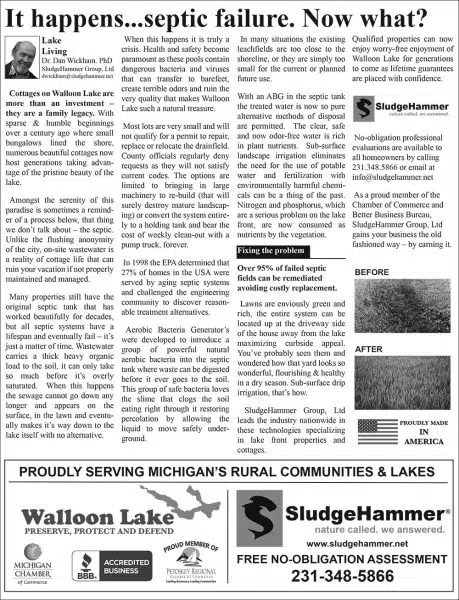
It happens… septic failure. Now what?

Cottages on Walloon Lake are more than an investment – they are a family legacy. With sparse & humble beginnings over a century ago where small bungalows lined the shore, numerous beautiful cottages now host generations taking advantage of the pristine beauty of the lake.

Amongst the serenity of this paradise is sometimes a reminder of a process below, that thing we don’t talk about – the septic. Unlike the flushing anonymity of the city, on-site wastewater is a reality of cottage life that can ruin your vacation if not properly maintained and managed.

Many properties still have the original septic tank that has worked beautifully for decades, but all septic systems have a lifespan and eventually fail – it’s just a matter of time. Wastewater carries a thick heavy organic load to the soil, it can only take so much before it’s overly saturated. When this happens the sewage cannot go down any longer and appears on the surface, in the lawn and eventually makes it’s way down to the lake itself with no alternative. When this happens it is truly a crisis. Health and safety become paramount as these pools contain dangerous bacteria and viruses that can transfer to bare feet, create terrible odors and ruin the very quality that makes Walloon Lake such a natural treasure.

Most lots are very small and will not qualify for a permit to repair, replace or relocate the drainfield. County officials regularly deny requests as they will not satisfy current codes. The options are limited to bringing in large machinery to re-build (that will surely destroy mature landscaping) or convert the system entirely to a holding tank and bear the cost of weekly clean-out with a pump truck, forever.

In 1998 the EPA determined that 27% of homes in the USA were served by aging septic systems and challenged the engineering community to discover reasonable treatment alternatives.

Aerobic Bacteria Generator’s were developed to introduce a group of powerful natural aerobic bacteria into the septic tank where waste can be digested before it ever goes to the soil. This group of safe bacteria loves the slime that clogs the soil eating right through it restoring percolation by allowing the liquid to move safely underground. In many situations the existing leachfields are too close to the shoreline, or they are simply too small for the current or planned future use.

With an ABG in the septic tank the treated water is now so pure alternative methods of disposal are permitted. The clear, safe and now odor-free water is rich in plant nutrients. Sub-surface landscape irrigation eliminates the need for the use of potable water and fertilization with environmentally harmful chemicals can be a thing of the past. Nitrogen and phosphorus, which are a serious problem on the lake front, are now consumed as nutrients by the vegetation.

Fixing the problem

Over 95% of failed septic fields can be remediated avoiding costly replacement.

Lawns are enviously green and rich, the entire system can be located up at the driveway side of the house away from the lake maximizing curbside appeal. You’ve probably seen them and wondered how that yard looks so wonderful, flourishing & healthy in a dry season. Sub-surface drip irrigation, that’s how.

SludgeHammer Group, Ltd leads the industry nationwide in these technologies specializing in lake front properties and cottages. Qualified properties can now enjoy worry-free enjoyment of Walloon Lake for generations to come as lifetime guarantees are placed with confidence. No-obligation professional evaluations are available to all homeowners by calling 231.348.5866 or email at info@sludgehammer.net.

As a proud member of the Chamber of Commerce and Better Business Bureau, SludgeHammer Group, Ltd gains your business the old fashioned way – by earning it.

Download Full Article


Posted in: Blog